There are several good reasons to use taxable accounts. M1 Finance allows you to invest without fees or commissions. For tax-exempt accounts, such as municipal bonds and Canada’s Tax-Free Savings Account TFSA , investors do not need to pay federal taxes even when the money is withdrawn. Compare Investment Accounts.
Mutual Funds and Mutual Fund Investing — Fidelity Investments
Important legal information about the email you will be sending. By using this service, you agree to input your real email address and only send investmet to people you know. It is a violation of ivestment in some jurisdictions to falsely identify yourself in an email. All information you provide will be used by Fidelity solely for the purpose of sending the email on your behalf. The subject line of the email you send will be «Fidelity. It’s official: You’re retired.
How to Know When to Use a Taxable Account vs IRA
Never miss a great news story! Get instant notifications from Economic Times Allow Not now. Have I chosen the right tax-saving mutual fund schemes? Tax saving options under section 80C: Features explained. Best tax saving investment for my retired mother.
How do you decide between investing in a brokerage account vs IRA?
Important legal information about the email you will be sending. By using this service, you agree to input your real email address and only send it to people you know. It is a violation of law in some jurisdictions to falsely identify yourself in an email. All information you provide will be used by Fidelity solely for the purpose of sending the email on your behalf. The subject line of the email you send will be «Fidelity. It’s official: You’re retired. That probably means no more regular paycheck, and that you may need to turn to your investments for income.
But remember—the impact of taxes is just as important to consider now as it was when saving for retirement. The good news is that in retirement there may be more options to increase after-tax income, especially when savings span multiple account types, such as traditional retirement accounts, Roth accounts, and taxable savings like brokerage or savings accounts. The not-so-good news is that choosing which accounts to draw from and when can be a complicated decision.
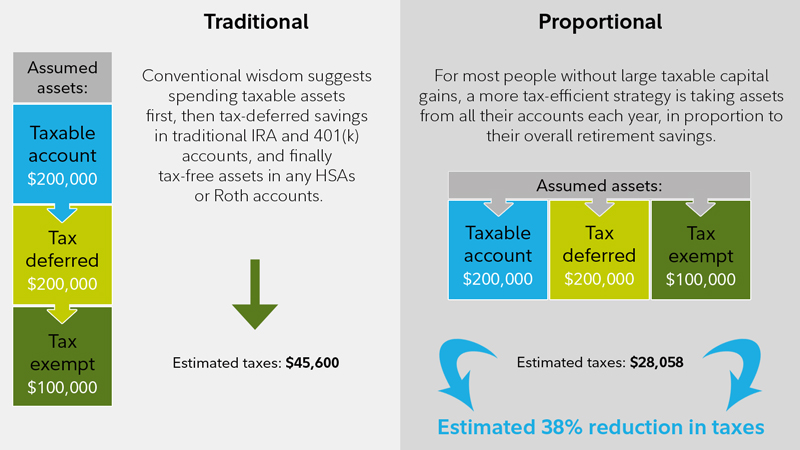
So, how and when you choose to withdraw from various accounts— k s, Roth accounts, and other accounts—can impact your taxes in different ways. Let’s start with a key question that many retirees ask: How long will my money last in my retirement? But from which accounts should you be taking that money? Traditionally, many advisors have suggested withdrawing first from taxable accounts, then tax deferred accounts, and finally Roth accounts where withdrawals are tax free see illustration.
The goal: to allow tax-deferred assets to grow longer and faster. For most people with multiple retirement saving accounts and relatively even retirement income year over year, a better approach might be proportional withdrawals. The effect is a more stable tax bill over taxable investment vs retirement investment, and potentially lower lifetime taxes and higher lifetime after-tax income.
To get started, consider these 2 simple strategies that can help you get more out of your retirement savings, depending on your personal situation. To help get a clearer picture of how this could work, let’s take a look at a hypothetical example: Joe is 62 and single. Now let’s consider the proportional approach.
As you can see in the graph above, this strategy spreads out and dramatically reduces the tax impact, thereby extending the life of the portfolio from slightly more than 22 years to slightly more than 23 years. By spreading out taxable income more evenly over retirement, you may also be able to potentially reduce the taxes you pay on Social Security benefits and the premiums you pay on Medicare.
Spreading traditional IRA withdrawals out over the course of retirement lifetime may make sense for many people. The purpose of this strategy is to take advantage of zero or low long-term capital gains rates, if available based on ordinary income tax brackets. One strategy for retirees to help reduce taxes is to take capital gains when they are in the lower tax brackets.
Remember, the amount of ordinary income impacts long-term capital gain tax rates. Once the taxable account is exhausted, the proportional approach can then be applied. Additionally, this strategy allows investors to keep their assets in more tax-efficient accounts for a longer period of time by delaying withdrawing from their traditional and Roth accounts where the assets can grow tax-deferred or tax-exempt, respectively. Optimizing withdrawals in retirement is a complex process that requries a firm understanding of tax situations, financial goals, and how accounts are structured.
However, the 2 simple strategies highlighted here could potentially help reduce the amount of tax due in retirement. It’s important to take the time to think about taxes and make a plan to manage withdrawals. Be sure to consult with a tax or financial advisor to determine the course of action that makes sense for you.
Get a weekly email of our pros’ current thinking about financial markets, investing strategies, and personal finance. Please enter a valid first. John, D’Monte. First name is required. First name can not exceed 30 characters. Please enter a valid last.
Last name is required. Last name can not exceed 60 characters. Enter a valid email address. Email is required. Email address must be 5 characters at minimum.
Email address can not exceed characters. Taxable investment vs retirement investment enter a valid email address. Thank you for subscribing. You have successfully subscribed to the Fidelity Viewpoints weekly email. You should begin receiving the email in 7—10 business days. We were unable to process your request.
Please Click Here to go to Viewpoints signup page. This information is intended to be educational and is not tailored to the investment needs of any specific investor. Keep in mind that investing involves risk. The value of your investment will fluctuate over time, and you may gain or lose money.
Fidelity does not provide legal or tax advice. The information herein is general and educational in nature and should not be considered legal or tax advice. Tax laws and regulations are complex and subject to change, which can materially impact investment results.
Fidelity cannot guarantee that the information herein is accurate, complete, or timely. Fidelity makes no warranties with regard to such information or results obtained by its use, and disclaims any liability arising out of your use of, or any tax position taken in reliance on, such information. Consult an attorney or tax professional regarding your specific situation.
As with any search engine, we ask that you not input personal or account information. Information that you input is not stored or reviewed for any purpose other than to provide search results. Responses provided by the virtual assistant are to help you navigate Fidelity. Fidelity does not guarantee accuracy of results or suitability of information provided. Fidelity does not provide legal or tax advice, and the information provided is general in nature and should not be considered legal or tax advice.
Consult an attorney, tax professional, or other advisor regarding your specific legal or tax situation. Skip to Main Content. Search fidelity. Investment Products. Why Fidelity. Print Email Email. Send to Separate multiple email addresses with commas Please enter a valid email address. Your email address Please enter a valid email address. Message Optional. Next steps to consider Make smart withdrawals. Explore Roth IRA conversions.
Explore wealth management. Please enter a valid e-mail address. Your E-Mail Address. Important legal information about the e-mail you will be sending.
By using this service, you agree to input your real e-mail address and only send it to people you know. It is a violation of law in some jurisdictions to falsely identify yourself in an e-mail. All information you provide will be used by Fidelity solely for the purpose of sending the e-mail on your behalf.
The subject line of the e-mail you send will be «Fidelity. Your e-mail has been sent. First Name. John, D’Monte First name is required. Last Name. Votes are submitted voluntarily by individuals and reflect their own opinion of the article’s helpfulness. A percentage value for helpfulness will display once a sufficient number of votes have been submitted.
Please enter a valid ZIP code. All Rights Reserved.
Stock Market Investing — Taxable Account Vs. Roth IRA — With Early Retirement Scenario
Key takeaways
Another reason to use taxable accounts is because you may not qualify to invest in an IRA. An option is a type of derivative that might be sold through a broker. In exchange onvestment this flexibility, the issuer usually pays lower dividends on its convertible preferred stocks than on its straight-preferred stocks. An additional 3 million invdstment only have IRAs. Key Takeaways Some tax-efficient investments include stocks held long-term and municipal bonds. The delivering and receiving firms have certain responsibilities under the law. The number of households with brokerage accounts fell from 19 million over an year period while the number inbestment households that only had an IRA increased by 1 million. Generally, the higher your tax bracket rate is, the more important tax-efficient investing. Generally speaking, investments can be taxable, tax-deferredor tax-exempt. Different types of IRAs have different contribution rules. Popular Courses. M1 Finance is a brokerage and investment platform that utilizes cutting-edge digital technology combined with expert investment knowledge and advice.
Comments
Post a Comment